Taking better pictures through keen observation

Updated: Nov 25, 2022
Every picture is an open book. To learn photography and videography, look at the work of the creator and observe what they have done. Watch the video clip below shot in Golkonda fort, Hyderabad, India. After watching it, pause and ask yourself what you notice. Try to think what was the videographer trying to do?
So, what did the cinematographer do make it interesting? Let's review each scene one by one.
Scene 1: Subject has been side lit. The light has a warm tone. Looks like an artificial light. The light is soft light and no harsh shadow

Scene 2: Natural window light is leveraged as a back light, sidelight & hair light
“A good photograph is knowing where to stand.” – Ansel Adams

Scene 3: Pink light is working as back light illuminating the back side of actor's face and also as hair light for the across. It's not by chance that the actor is facing that direction. Do you see a pattern emerging ?

Scene 4: Frame in Frame. Within the camera frame, there is another frame of window. Inside the window frame, the actress has been side lit from orange light from the left, we also see hair light from the top which is white in color. To separate the actress from the brick wall, they have added a low intensity light on the wall. The room is light be a night lamp to separate the subject sitting in the root from its background. Looks like a 5-light setup.
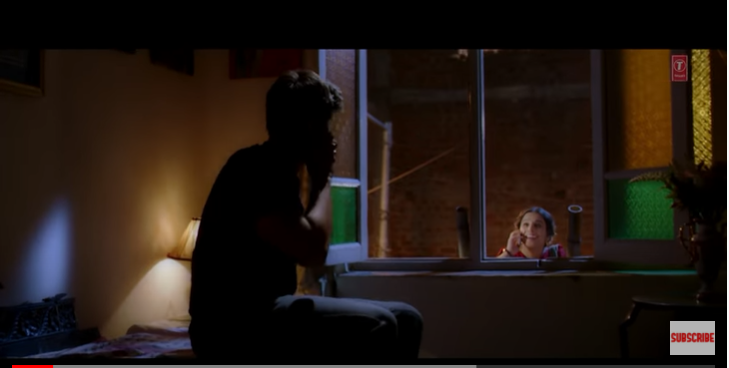
Scene 5: Leveraging silhouette to create interest. What could be the reason behind including this scene in the song? It is a different visual effect. The 3-minute song is packed with as many visual effects to captivate users.

Scene 6: Rule of thirds. The top of Golkonda fort is placed by following rule of third. The protruding wall creates a diagonal line creating a sense of depth in the frame

Scene 6: Rule of thirds. Note that the face of the actor is placed exactly at the point which intersects the image in one third, both vertically as well as horizontally.
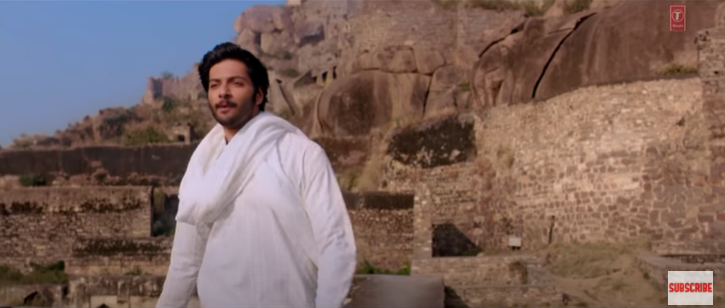
Scene 7: Rule of third. You should know that viewers' attention gravitates to the brightest and sharpest point in the scene. In the picture below your eyes will naturally gravitate to the white dress, whether you like it or not. The blurry and dark rock does not hold your attention. This simple principle is used while preparing corporate presentations, in product branding & advertisements, while separating a movie star from the pack of dancers behind him.

Scene 9: Frame in Frame + Texture. The subject is asked to walk between two walls such that these walls make a rectangular frame with the cameras frame. Your eyes will naturally gravitate towards him as he placed at the brightest spot in the image.

Scene 10: Rule of third. Again, we observe that the brightest object is placed strategically so that it follows the rule of third. Your eyes naturally gravitate toward that point.

Scene 11: Rule of third. Diagonal line led to the brightest element in the frame and conveys sense of depth.

Scene 12: Both the foreground and background elements are placed such that they are following the rule of third. Is it by chance that the hero is wearing a white dress?

Scene 13: Rule of thirds + Diagonal line. Notice how the camera has been tilted in the image below to create diagonal leading line which to guide your eye till the top of staircase. The lady is made to wear a bright dress to attract your eyeballs. Everything is intentional.

Scene 14: Diagonal line. Artificial light from camera right on subjects face.

Scene 15: Natural light as hair light / backlight

Scene 16: Frame in frame. Subjects placed inside the frame in the dome.

Scene 17: Crystals are used to create a frame inside cameras frame in the next image.
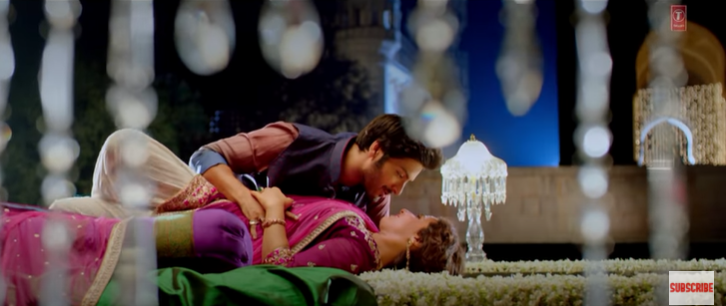
We saw that few patterns kept repeating. You might have noted that I kept observing the direction and nature of light. Photography literally means drawing with light! The Greek word "Phos" means light and "Graphe" means drawing. You are painting on the sensor of your camera with light. And yes, did you notice that the editor kept changing scenes after every 3 seconds? Go back and watch the view again and count when the scene changes. Our attention span is less than that of a goldfish. The fact that you have come this far is a proof that I have done a good job of engaging you. :-)
Now the next time you watch TV, or a movie observe the work of cinematographers. You never know what they will teach you. I hope you found this article interesting.
Bye for now. Cheers!

Comments